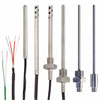
Pt100
Introduction to Resistance Temperature Detectors (RTD)
RTD - or Resistance Temperature Detectors - is a
temperature sensor that contain a resistor that changes resistance value as its
temperature changes. They have been used for many years to measure temperature in laboratory and industrial processes, and have developed a
reputation for accuracy, repeatability, and stability.
Most RTD elements consist of a length of fine coiled wire wrapped around a ceramic or glass core. The element is usually quite fragile, so it is
often placed inside a sheathed probe to protect it. The temperature sensor is made from a pure material whose resistance at various temperatures has been
documented. The material has a predictable change in resistance as the temperature changes; it is this predictable change that is used to determine
temperature.
This page will help you better understand RTDs, but you can also speak to our application engineers at anytime if you have any
special measurement challenges.

Learn more about RTDs

Benefits of Using a pt100
The pt100 is one of the most accurate temperature sensors. Not only does it provide good accuracy, it also provides excellent stability and
repeatability. Most OMEGA standard pt100 comply with DIN-IEC Class B.
pt100 are also relatively immune to electrical noise and therefore well suited for temperature measurement in industrial environments,
especially around motors, generators and other high voltage equipment.
Construction of a RTD Probe
A probe is an assembly composed of an element, a sheath, a lead wire, and a termination or connection. Once the sensor is selected,
the wiring and packaging requirements need to be determined. There are a number of ways to wire the sensors,
along with an unlimited number of probe or sensor constructions to choose from.
 Wiring Arrangement
In order to measure temperature, the RTD element must be connected to some sort of monitoring or control equipment. Since the temperature
measurement is based on the element resistance, any other resistance (lead wire resistance, connections, etc.) added to the circuit will result in
measurement error. Except for the 2-wire configuration, all other wiring arrangements allow the monitoring or control equipment to factor out
the unwanted lead wire resistance and other resistances that occur in the circuit. Sensors using the 3-wire construction are the most
common design, found in industrial process and monitoring applications. The lead wire resistance is factored out as long as all of the lead
wires have the same resistance; otherwise, errors can result.
Wire Materials
Origin Story of the RTD
The discovery that resistivity of metals showed a marked temperature dependence was made by Sir Humphrey Davy the same year Seebeck made his discovery about thermoelectricity. Fifty years later, Sir William Siemens proffered the use of platinum as the element in a resistance thermometer.
When specifying the lead wire materials, care should be taken to select the right lead wires for the temperature and environment the sensor will
be exposed to in service. When selecting lead wires, temperature is by far the primary consideration, however, physical properties such as abrasion
resistance and water submersion characteristics can also be important. The three most popular constructions are:
- PVC Insulatated Probes offer a temperature range of -40 to 105°C, with goood Abrasion Resistance and applicable for Water Submersion.
- PFA Insulatated pt100 Probes offer a temperature range of -267 to 260°C with Excellent Abrasion Resistance. They are also great for
Water Subersion Applications.
- Although Fiberglass Insulated pt100 Probes offer a higher temperature range of -73 to 482°C, its performance under abrasion or water
submersion is considered to be not as effective.
The Termination
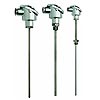
Probes may be terminated in a connection head, quick disconnect, terminal block, or extension wire. Other termination styles are available
upon special request.
Configuration
Once the pt100 element, wire arrangement, and wire construction are selected, the physical construction of the sensor needs to be
considered. The final sensor configuration will depend upon the application. Measuring the temperature of a liquid, a surface,
or a gas stream requires different sensor configurations.
The Most Common Resistance Materials for RTDs are:
1. Platinum (most popular and accurate)
2. Nickel
3. Copper
4. Balco (rare)
5. Tungsten (rare)
RTD standards
There are two standards for platinum RTDs: the European standard (also known as the DIN or IEC standard) and the American standard. The European standard,
also known as the DIN or IEC standard, is considered the world-wide standard for platinum RTDs. This standard, DIN/IEC 60751 (or simply IEC751), requires
the RTD to have an electrical resistance of 100.00 O at 0°C and a temperature coefficient of resistance (TCR) of 0.00385 O/O/°C between 0 and 100°C.
There are two resistance tolerances specified in DIN/IEC751:
Class A = ±(0.15 + 0.002*t)°C or 100.00 ±0.06 O at 0ºC
Class B = ±(0.3 + 0.005*t)°C or 100.00 ±0.12 O at 0ºC
Two resistance tolerances used in industry are:
1/3 DIN = ±1/3* (0.3 + 0.005*t)°C or 100.00 ±0.10 O at 0ºC
1/10 DIN = ±1 /10* (0.3 + 0.005*t)°C or 100.00 ±0.03 O at 0ºC
The combination of resistance tolerance and temperature coefficient define the resistance vs. temperature characteristics for the RTD sensor.
The larger the element tolerance, the more the sensor will deviate from a generalized curve, and the more variation there will be from sensor to sensor
(interchangeability). This is important to users who need to change or replace sensors and want to minimize interchangeability errors.
Choose the right pt100
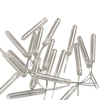 pt100 Elements
The pt100 element is the simplest form of RTD. It consists of a piece of wire wrapped around a ceramic or glass core. Because of their
compact size, pt100 elements are commonly used when space is very limited.
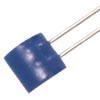 pt100 Surface Elements
A surface element is a special type of pt100 element. It is designed to be as thin as possible thus providing good contact
for temperature measurement of flat surfaces.
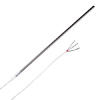 pt100 Probes
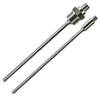
The pt100 probe is the most rugged form of RTD. A probe consists of an pt100 element mounted inside a metal tube,
also known as a sheath. The sheath protects the element from the environment. OMEGA offers a wide variety of probes in various configurations.
Frequently Asked Questions
Each type of temperature sensor has a particular set of conditions for which it is best suited. RTDs offer several advantages:
• A wide temperature range (approximately -200 to 850°C)
• Good accuracy (better than thermocouples)
• Good interchangeability
• Long-term stability
With a temperature range up to 850°C, RTDs can be used in all but the highest-temperature industrial processes. When made using metals such as
platinum, they are very stable and are not affected by corrosion or oxidation. Other materials such as nickel, copper, and nickel-iron alloy have also
been used for RTDs. However, these materials are not commonly used since they have lower temperature capabilities and are not as stable or
repeatable as platinum.
Measuring the temperature of a liquid with an RTD
Probe-type sensor styles are normally used for measuring liquids. They can be as simple as our
general purpose RTD Probes PR-10 and PR-11 constructions,
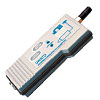
or as involved as our PR-12, 14, 18, or 19—with connection heads and
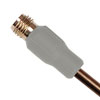
temperature transmitters. A popular choice is the quick-disconnect sensor. This can be used
as is, with compression fittings for flexible installation, or with our PRS plastic handle for a handheld probe. When measuring the temperature of harsh environments such as plating baths or highly pressurized systems, sensors can be coated with
a material like PFA Teflon®, or they can be housed in a thermowell to protect the sensor from extreme conditions.
Air and Gas Temperature Measurement with RTD Sensors
Air and gas stream measurements are a challenge because the rate of transfer of temperature from the fluid to the sensor is slower than for
liquids. Therefore, sensors specifically designed for use in air or gas place the sensing element as close to the media as possible.
These
Air Temperature RTD Sensors allow the sensing element to be nearly in
direct contact with the air stream. With a housing design containing lots that allow the air to flow past the element, this construction
is very popular in measuring air temperature in laboratories, clean rooms, and other locations. When the situation requires a little more
protection for the sensor, an option is to use a design similar to the RTD-860. This design has a small diameter probe with a flange for
mounting. The configuration will be a little slower to respond to changes in the air stream, but it will provide improved protection for the sensor.
Surface Temperature Measurements
Measuring the temperatute of a surface can be one of the most difficult to make accurately. There are a wide variety of styles to choose from, depending on
how you want to attach the sensor, how sensitive to changes in temperature the sensor has to be, and whether the installation will be permanent.
The most accurate and fastest-responding surface RTD is our SA1-RTD sensor. When applied to a surface, it becomes virtually a part of the
surface it is measuring. Surface sensors can also be bolted, screwed, glued, or cemented into place. The RTD-830 has a pre-machined hole in
the housing to allow for easy installation with a #4 screw. The RTD-850 has a housing with threaded tip that allows it to be installed into a standard
#8-32 threaded hole. This RTD is handy for measuring the temperature of heat sinks or structures where screw holes may already exist.
RTD Glossary
RTD (Resistance Temperature Detector)
An acronym for resistance temperature detector or device. A resistance temperature detector operates on the principle of the change in
electrical resistance in wire as a function of temperature.
RTD Element
Sensing portion of the RTD which can be made most commonly of platinum, nickel, or copper. OMEGA features two styles of elements: wire wound and thin film.
RTD Probe
An assembly composed of an element, a sheath, a lead wire, and a termination or connection. The standard OMEGA™ RTD probe is made with a 100 ohm
platinum European curve element (alpha = 0.00385).
Platinum RTD
Also known as Pt RTD, Platinum RTD's are typically the most linear, stable, repeatable, and accurate of all RTD's. Platinum wire was
chosen by OMEGA because it best meets the needs of precision thermoetry.
Thin Film RTD
Thinfilm RTD's are made up of of a thin layer of a base metal embedded into a ceramic substrate and trimmed to produce the desired resistance
value. OMEGA RTD's are made by depositing platinum as a film on a substrate and then encapsulating both. This method allows for the production of
small, fast response, accurate sensors. Thin film elements conform to the European curve/DIN 43760 standards and the "0.1% DIN" standard tolerance.
Class A RTD
Highest RTD Element tolerance and accuracy, Class A (IEC-751), Alpha = 0.00385
Class B RTD
Most Common RTD Element tolerance and accuracy, Class B (IEC-751), Alpha = 0.00385
Aplha .00385 Curve
European Curve meets "0.1% DIN" standard tolerance and conforms to the DIN 43760 standard
Sheath
The sheath, a closed end tube, immobilizes the element, protecting it against moisture and the environment to be measured. The sheath also provides
protection and stability to the transition lead wires from the fragile element wires. OMEGA’s standard sheaths are 3 mm (1/8") and 6 mm (1/4") O. D.
304 stainless steel tubes. Other O.D.’s and materials are available upon request.
Allowable Deviation from Calibration Values
| Temperature | Ohms | Deviation
Degrees | Temperature | Ohms | Deviation
Degrees |
| °C | °F | °C | °F | °C | °F | °C | °F |
-200
-100
0
100
200
300 |
-328
-148
32
212
392
572 |
±0.56
±0.32
±0.12
±0.30
±0.48
±0.64 |
±1.3
±0.8
±0.3
±0.8
±1.3
±1.8 |
±2.34
±1.44
±0.54
±1.44
±2.34
±3.24 |
400
500
600
700
800
850 |
752
932
1112
1292
1472
1562 |
±0.79
±0.93
±1.06
±1.17
±1.28
±1.34 |
±2.3
±2.8
±3.3
±3.8
±4.3
±4.6 |
±4.14
±5.04
±5.94
±6.84
±7.74
±8.28 |
↓ View this page in another language or region ↓
 CLOSE
CLOSE






 pt100
pt100 RTD
RTD RTD
RTD RTD
RTD RTD
RTD pt100
pt100 pt100
pt100 Einführung zu Widerstandsfühlern
 pt100
pt100 pt100
pt100 pt100
pt100 pt100
pt100 RTD
RTD RTD
RTD RTD
RTD
 RTD 入門
 RTD 온도센서
 RTD
RTD
 RTD
RTD
 RTD
RTD
 RTD
RTD
 RTD
RTD