Thermocouple Sensor
What is a thermocouple?
A
thermocouple is a
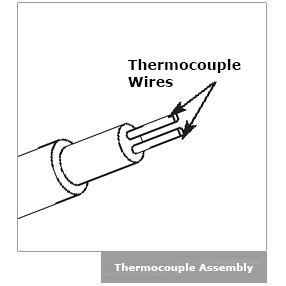
sensor for measuring temperature. This sensor consists of two dissimilar metal wires, joined at one end, and connected to
a thermocouple thermometer or other thermocouple-capable device at the other end. When properly configured, thermocouples can provide temperature measurements
over wide range of temperatures.
Thermocouples are known for their versatility as temperature sensors therefore commonly used on a wide range of applications - from an industrial usage thermocouple to a regular thermocouple found on utilities and regular appliances. Due to their wide range of models and technical specifications, it is extremely important to understand its basic structure, how it works, its ranges as to better determine what is the right type and material of thermocouple for your application.
Choose the right thermocouple
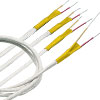 Beaded Wire Thermocouple
A beaded wire thermocouple is the simplest form of thermocouple. It consists of two pieces of thermocouple wire joined together with a welded bead. Because the bead of the thermocouple is exposed, there are several application limitations. The beaded wire thermocouple should not be used with liquids that could corrode or oxidize the thermocouple alloy. Metal surfaces can also be problematic. Often metal surfaces, especially pipes are used to ground electrical systems The indirect connection to an electrical system could impact the thermocouple measurement. In general, beaded wire thermocouples are a good choice for the measurement of gas temperature. Since they can be made very small, they also provide very fast response time.
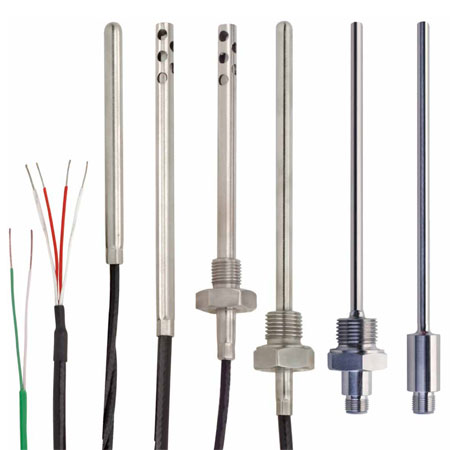
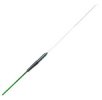 Thermocouple Probe
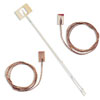
A thermocouple probe consists of thermocouple wire housed inside a metallic tube. The wall of the tube is referred to as the sheath of the probe. Common
sheath materials include stainless steel and Inconel®. Inconel supports higher temperature ranges than stainless steel, however, stainless steel is often
preferred because of its broad chemical compatibility. For very high temperatures, other exotic sheath materials are also available. View our line of high
temperature exotic thermocouple probes.
The tip of the thermocouple probe is available in three different styles. Grounded, ungrounded and exposed. With a grounded tip the thermocouple is in
contact with the sheath wall. A grounded junction provides a fast response time but it is most susceptible to electrical ground loops. In ungrounded
junctions, the thermocouple is separated from the sheath wall by a layer of insulation. The tip of the thermocouple protrudes outside the sheath wall with an exposed junction. Exposed junction thermocouples are best suited for air measurement.
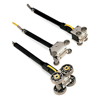 Surface Probe
Measuring the temperature of a solid surface is difficult for most types of temperature sensors. In order to assure an accurate measurement, the entire
measurement area of the sensor must be in contact with the surface. This is difficult when working with a rigid sensor and a rigid surface. Since
thermocouples are made of pliable metals, the junction can be formed flat and thin to provide maximum contact with a rigid solid surface. These thermocouples
are an excellent choice for surface measurement. The thermocouple can even be built in a mechanism which rotates, making it suitable for measuring the
temperature of a moving surface. Type K is ChrOMEGA™/AlOMEGA™.
Learn more about thermocouples

How does a thermocouple work?
When two wires composed of dissimilar metals are joined at both ends and one of the ends is heated, there is a continuous current which flows in the
thermoelectric circuit. If this circuit is broken at the center, the net open circuit voltage (the Seebeck voltage) is a function of the junction
temperature and the composition of the two metals. Which means that when the junction of the two metals is heated or cooled a voltage is produced that can be correlated back to
the temperature.
Thermocouple types
Thermocouples are available in
different combinations of metals or calibrations. The most common are the “Base Metal” thermocouples known as N, T, E, J
and K Types. There are also high temperature calibrations - als known as Noble Metal thermocouples - Types R, S, C and GB.
Each calibration has a different temperature range and environment, although the maximum temperature varies with the diameter of the wire used in the
thermocouple.
Although the thermocouple calibration dictates the temperature range, the maximum range is also limited by the diameter of the thermocouple
wire. That is, a very thin thermocouple may not reach the full temperature range.
K Type Thermocouples are known as general purpose
thermocouple due to its low cost and temperature range.
| Common Thermocouple Temperature Ranges |
Calibration |
Temperature
Range |
Standard Limits
of Error |
Special Limits
of Error |
| J |
0° to 750°C
(32° to 1382°F) |
Greater of 2.2°C
or 0.75% |
Greater of 1.1°C
or 0.4% |
| K |
-200° to 1250°C
(-328° to 2282°F) |
Greater of 2.2°C
or 0.75% |
Greater of 1.1°C
or 0.4% |
| E |
-200° to 900°C
(-328° to 1652°F) |
Greater of 1.7°C
or 0.5% |
Greater of 1.0°C
or 0.4% |
| T |
-250° to 350°C
(-328° to 662°F) |
Greater of 1.0°C
or 0.75% |
Greater of 0.5°C
or 0.4% |
If you need a
calibration certificate for your thermocouple probes, Omega Calibration Services can provide you with one. Contact us.
How to choose a thermocouple
- Determine the application where the thermocouple sensor will be used
- Analyze the probe ranges the thermocouple will be exposed to
- Consider any chemical resistance needed for the thermocouple or sheath material
- Evaluate the need of abrasion and vibration resistance
- List any thermocouple installation requirements
How do I choose a thermocouple type?
Because a thermocouple measures in wide temperature ranges and can be relatively rugged, thermocouples are very often used in industry.
The following criteria are used in selecting a thermocouple:
- Temperature range
- Chemical resistance of the thermocouple or sheath material
- Abrasion and vibration resistance
- Installation requirements (may need to be compatible with existing equipment; existing holes may determine probe diameter)
A time constant has been defined as the time required by a sensor to reach 63.2% of a step change in temperature under a specified set of conditions.
Five time constants are required for the sensor to approach 100% of the step change value. An exposed junction thermocouple offers the fastest response.
Also, the smaller the probe sheath diameter, the faster the response, but the maximum temperature may be lower. Be aware, however, that sometimes the
probe sheath cannot withstand the full temperature range of the thermocouple type. Learn more about
thermocouple response times .
How do I know which junction type to choose?
Sheathed thermocouple probes are available with one of three junction types: grounded, ungrounded or exposed.
At the tip of a grounded junction probe, the thermocouple wires are physically attached to the inside of the probe wall. This results in good heat transfer
from the outside, through the probe wall to the thermocouple junction. In an ungrounded probe, the thermocouple junction is detached from the probe wall.
Response time is slower than the grounded style, but the ungrounded offers electrical isolation.
The thermocouple in the exposed junction style protrudes out of the tip of the sheath and is exposed to the surrounding environment. This type offers the best response time, but is limited in use to noncorrosive and nonpressurized applications. See the illustrations at the right for a full discussion of junction types.

The grounded junction is recommended for the measurement of static or flowing corrosive gas and liquid temperatures and for high pressure applications. The junction of a grounded thermocouple is welded to the protective sheath giving faster response than the ungrounded junction type.

An ungrounded junction is recommended for measurements in corrosive environments where it is desirable to have the thermocouple electronically isolated from and shielded by the sheath. The welded wire thermocouple is physically insulated from the thermocouple sheath by MgO powder (soft).

An exposed junction is recommended for the measurement of static or flowing non-corrosive gas temperatures where fast response time is required. The junction extends beyond the protective metallic sheath to give accurate fast response. The sheath insulation is sealed where the junction extends to prevent penetration of moisture or gas which could cause errors.


Frequently Asked Questions
What are the accuracies and temperature ranges of the various thermocouples?
You can find out more about thermocouple accuracy and temperature ranges on this
thermocouple color code
table. It is important to remember that both accuracy and range depend on such things as the
thermocouple alloys, the temperature being measured, the construction of the sensor, the material of the sheath, the media being measured, the state of the
media (liquid, solid, or gas) and the diameter of either the thermocouple wire (if it is exposed) or the sheath diameter (if the thermocouple wire is not
exposed but is sheathed).
Should I use a grounded or ungrounded probe?
It depends on the instrumentation. If there is any chance that there may be a reference to ground (common in controllers with nonisolated inputs), then an
ungrounded probe is required. If the instrument is a handheld meter, then a grounded thermocouple probe can almost always be used.
Can I use any multimeter for measuring temperature with thermocouples?
The magnitude of the thermoelectric voltage depends on the closed (sensing) end as well as the open (measuring) end of the particular thermocouple alloy leads.
Temperature sensing instruments that use thermocouples take into account the temperature of the measuring end to determine the temperature at the sensing end.
Most millivoltmeters do not have this capability, nor do they have the ability to do non-linear scaling to convert a millivoltage measurement to a
temperature value. It is possible to use lookup tables to correct a particular millivoltage reading and calculate the temperature being sensed. However, the
correction value needs to be continuously recalculated, as it is generally not constant over time. Small changes in temperature at the measuring instrument
and the sensing end will change the correction value.
How to choose between thermocouples, resistance temperature detectors (RTD’s), thermistors and infrared devices?

You have to consider the characteristics and costs of the various sensors as well as the available instrumentation. In addition, Thermocouples generally can
measure temperatures over wide temperature ranges, inexpensively, and are very rugged, but they are not as accurate or stable as RTD’s and thermistors. RTD’s
are stable and have a fairly wide temperature range, but are not as rugged and inexpensive as thermocouples. Since they require the use of electric current to
make measurements, RTD’s are subject to inaccuracies from self-heating. Thermistors tend to be more accurate than RTD’s or thermocouples, but they have a much
more limited temperature range. They are also subject to selfheating. Infrared Sensors can be used to measure temperatures higher than any of the other devices
and do so without direct contact with the surfaces being measured. However, they are generally not as accurate and are sensitive to surface radiation
efficiency (or more precisely, surface emissivity). Using fiber optic cables, they can measure surfaces that are not within a direct line of sight.
For further information
about differences between Thermocouple, RTDs and Thermistor read this article.
What are the two most often
overlooked considerations in
selecting an infrared temperature
measuring device?
The surface being measured must
fill the field of view, and the surface
emissivity must be taken into
account.
How many feet of T/C wire can I run?
For a specific instrument, check its specifications to see if there are any limits to the input impedance. However as a rule of thumb, limit the resistance to 100 Ohms resistance maximum, and this depends on the gage of the wire; the larger the diameter, the less resistance/foot, the longer the run can be. However, if the
environment is electrically noisy, then a
temperature transmitter may be required which transmits a 4-20 mA signal that can be run longer distances and is more resistant to noise.
The Seebeck Effect
In 1821 Thomas Seebeck discovered the continuous current flow in the thermoelectric circuit when two wires of dissimilar metals are joined at both
ends and one of the ends is heated.
Can I split my one T/C signal to two separate instruments?
No. The T/C signal is a very lowlevel millivolt signal, and should only be connected to one device. Splitting to two devices may result in bad readings or loss of signal. The solution is to use a “dual” T/C probe, or convert one T/C output to a 4-20 mA signal by using a
transmitter or signal conditioner; then the new signal can be sent to more than one instrument.
Thermocouple Reference Tables
Thermocouples produce a voltage output that can be correlated to the temperature that the thermocouple is measuring. The documents in the table below
provide the thermoelectric voltage and corresponding temperature for a given thermocouple type. Most of the documents also provide the thermocouple
temperature range, limits of error and environmental considerations.
Thermocouples | Related Products
↓ View this page in another language or region ↓
 CLOSE
CLOSE







 Termopar
 Thermocouples - French
 Termopares
 Termopares
 Thermocouples
 Termokobler
 Thermocouples
 Thermoelementen
 Termocoppie
 Thermocouples
 Termopares
 Thermocouples
 Thermocouples
 热电偶
热电偶 Thermocouples
 熱電対
熱電対 열전대
열전대 Thermocouples
 Thermocouples
 Thermocouples
 Thermocouples
 Thermocouples